
Architecture
Package layout
Section titled “Package layout”| Area | Path | Role |
|---|---|---|
| Orchestrator | phenome.pipeline |
PhenoMe class; user-facing workflow. |
| Mixins | phenome.mixins |
Behaviour split into dataset, embeddings, properties, distances, analysis, visualization, interactive. |
| Core algorithms | phenome.core |
DR, correlation, interpretability, results container (PhenoMeResults), export, validation. |
| I/O | phenome.io |
Images, checkpoints, file discovery. |
| Metadata | phenome.metadata |
MetadataBase and concrete extractors. |
| Utilities | phenome.utils |
Model wrappers, transforms, metadata helpers, property factories. |
| Plugins | phenome.plugins |
Registries for properties, metadata extractors, report sections. |
| Report | phenome.report |
HTML report generation. |
Imports for users are mostly from phenome (re-exports). See the
Function location guide for a full symbol
index.
How the source is split
Section titled “How the source is split”PhenoMe (phenome/pipeline.py) is the session: the file table, embeddings,
properties, the open checkpoint, and the run log. It inherits one mixin per
capability and calls the packages below. Scientists import from phenome;
phenome/__init__.py only re-exports that public surface. A module whose
name starts with _ is package-private.
| Area | How the files are split |
|---|---|
| Properties | PhenoMeProperties lives in mixins/properties/main.py. Computation, grouping, workers, and path handling are sibling modules (_compute.py, grouping.py, matrix.py, _workers.py, _paths.py). |
| Plots | PhenoMeVisualization in mixins/visualization/_core.py stacks one mixin per plot family (_dr_plots.py, _image_display.py, _distance_plots.py, and the correlation, enrichment, and interpretability plot modules) plus _helpers.py. |
| Analysis, distances, batch correction | mixins/analysis.py, distances.py, batch_correction.py. Analysis computes; visualization draws. |
| Interactive explorers | mixins/interactive/, imported when first used. Shared markup is _html_components.py. |
| Core | Containers and math with no session of their own: PhenoMeResults, the processing-pipeline record, the run log, and core/math/. |
| I/O | read_image and FileDiscovery in io/discovery.py. CheckpointManager in io/checkpoint.py, serialization in _checkpoint_ops.py, resume matching in checkpoint_alignment.py. |
| Report | report/generator.py assembles the page. One section per file under report/sections/. CSS, JavaScript, and HTML fragments are separate modules. |
Data flow (typical run)
Section titled “Data flow (typical run)”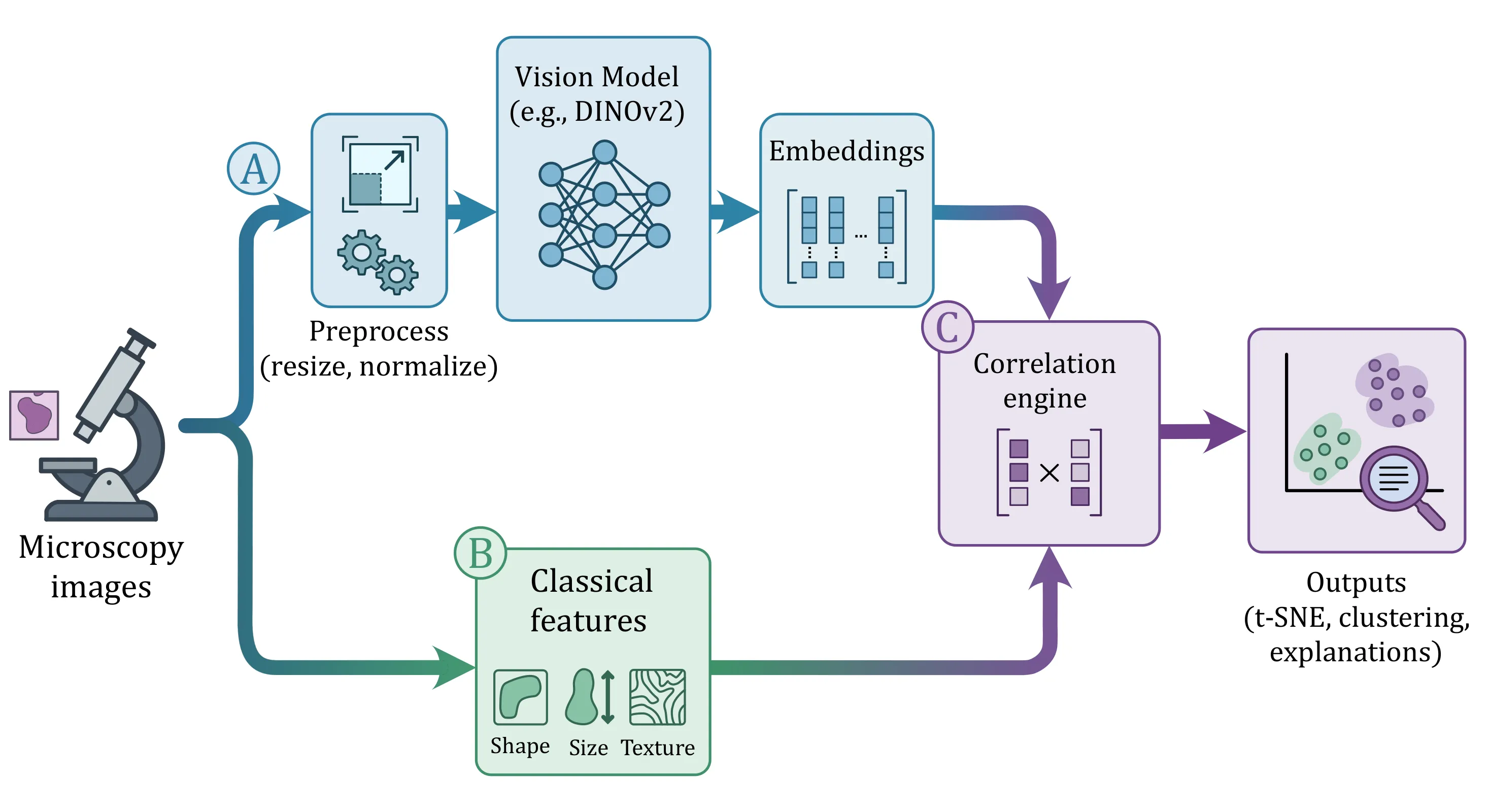
The typical data flow maps directly to the pipeline overview components:
- Discovery (Input) — Gather raw image paths and experimental metadata.
- Embeddings (A) — Batch inference through a
ModelWrapperto extract visual fingerprints. - Properties (B) — Parallel computation of classical features from images/masks.
- Analysis & Visualization (C) — Combine embeddings and properties for quantification and plotting.
Extension points
Section titled “Extension points”| Goal | Where to start |
|---|---|
| Custom metadata from paths or tables | Experiment details, MetadataBase, get_metadata_from_path, make_dataframe_metadata_fn. |
| Custom image features | Select properties, phenome.plugins.register_property. |
| Custom vision backbone | Model wrapper API; subclass ModelWrapper. |
| Report sections | Extending PhenoMe, register_report_section. |
Rule of thumb: prefer hooks (metadata_fn, property factories,
plugins) before forking PhenoMe internals.
Where should I add code?
Section titled “Where should I add code?”A public method stays the sequence a reader can follow: check inputs, call the computation, store the result, log the step. The formula, the figure, and the array reshaping go in a sibling module. Properties and visualization are the pattern to copy. Name the file for that one job.
A module of a few hundred lines is the normal size. Move helpers out before
adding another large function. pipeline.py, mixins/interactive/explorer.py,
mixins/analysis.py, io/checkpoint.py, core/processing_pipeline.py, and
mixins/properties/_compute.py already hold whole subsystems. New behavior
there is a new module those files call.
| Adding… | Prefer |
|---|---|
| A workflow step that needs the session | The mixin for that step. A new capability is a new mixin on class PhenoMe. |
| Math on arrays (DR, correlation, stats) | phenome/core/math/. |
| Images, paths, HDF5 | phenome/io/. |
| A plot | A new _*.py mixin under mixins/visualization/, composed in _core.py. |
| A classical image feature | phenome/utils/property_factories.py, or phenome/plugins when users register it. |
| A block of the HTML report | phenome/report/sections/. |
| Metadata from a path or a table | phenome/metadata/. |
| A name users import | Re-export it from phenome/__init__.py. |
Public functions and classes use NumPy-style docstrings (quantity, array shape, conditions). The API pages are generated from those docstrings. See the Developer guide.